

Do you know what Factors Affecting the Screening Process
Jul 31, 2026A small particle has no difficulty falling though a screen aperture, but the nearer its minimum cross-section is to that of the retaining mesh the more difficulty it will have in hitting an open mesh centrally and passing through, that is, the greater the ratio is to unity the greater the difficulty
The percentage open area of the screen depends on the size of the holes and the diameter of the screen wire. In general, the smaller the size of the aperture the lower the percentage of open area. The percentage of open area will also depend on the shape of the apertures, that is, it will be greater for screen cloth with rectangular openings than for that of the
same nominal size having square openings.
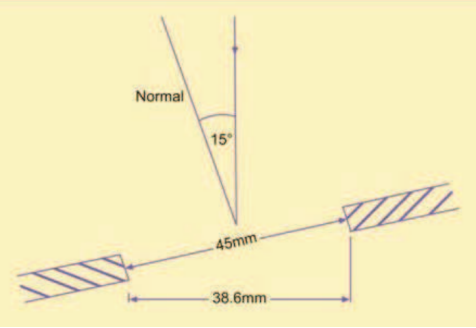
A particle, in order to have the best chance of passing through an aperture, should present its minimum cross-section normally to the screen, that is, at zero angle of incidence, Figure 1.
Figure 1 Diagram showing effect of the angle of the angle of incidence on
The spread of the feed over the screen is important, as the wider the spread the better the chance a particle has of finding an unobstructed passage to the surface of the screen. The kinetic energy of a particle should be low, otherwise it will tend to move horizontally on top of the layer of feed instead of making its way through to the screen surface. Moisture in the feed and the stickiness of particles tend to cause small particles to cling to larger ones. Pressure of particles riding above those next to the screen tends to force near-size particles through the aperture.
How to select the right mobile screener to screen your materials? Please feel free to contact Borgers for consultation.


No. 128, Gaocuotou, Yin Village, Huangtang Town, Hui'an County, Fujian Province,China
© 2025 Quanzhou Borgers Construction Machinery Co.,Ltd All Rights Reserved.


